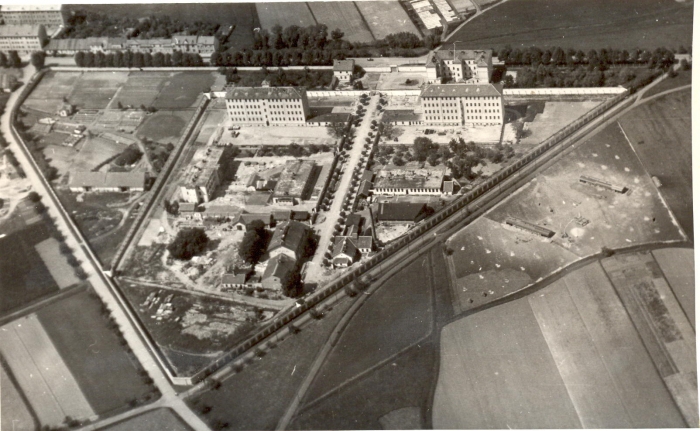
Marie Mrvová: Women Political Prisoners and Prison Culture in Czechoslovakia 194
Aerial photograph of Pardubice prison, c. 1945. ‘Published with the permission of Pardubice prison’ http://vscr.cz/veznice-pardubice/o-nas/fotografie/
My name is Marie Mrvova and I am studying MA by Research in Public History, Oral History and Community Heritage at University of Huddersfield. I also work as a collector and editor for Memory of Nations (Paměť národa), Czech oral history project lead by Post-bellum, Czech radio (Český rozhlas) and Institute for Studies of Totalitarian Regimes. My current research focuses on women political prisoners and prison culture in Czechoslovakia 1948–1968.
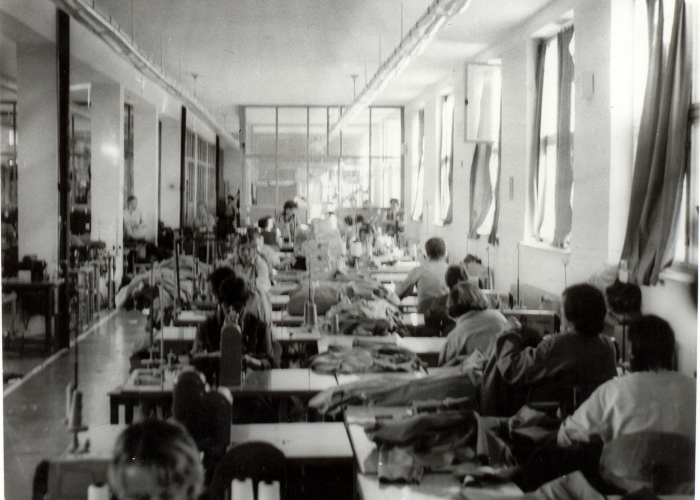
Women’s experience of persecution in Communist Czechoslovakia is still under-researched, especially there is a lack of research about prison culture. Another reason for choosing this topic is to counteract the loss of memory. I intend to tell the stories of those women who were meant to be forgotten. I selected seven women: a nun and superior general of the Sisters of Mercy of St. Borromeo Vojtěcha Hasmandová, author and poet Božena Kuklová-Jíšová, author and journalist Albína Palkosková-Wiesenbergerová, author Nina Svobodová, author of the famous book Byly jsme tam taky Dagmar Šimková, professor of art history and classical archaeology Růžena Vacková and my great-grandmother and Catholic activist Marie Kovalová. Both my great-grandparents were political prisoners in the 1950s and the 1960s. I believe that personal testimonies help us to imagine how the lives of individuals during Communism looked like and they can lead to a better understanding of human behaviour under the repressive regime.
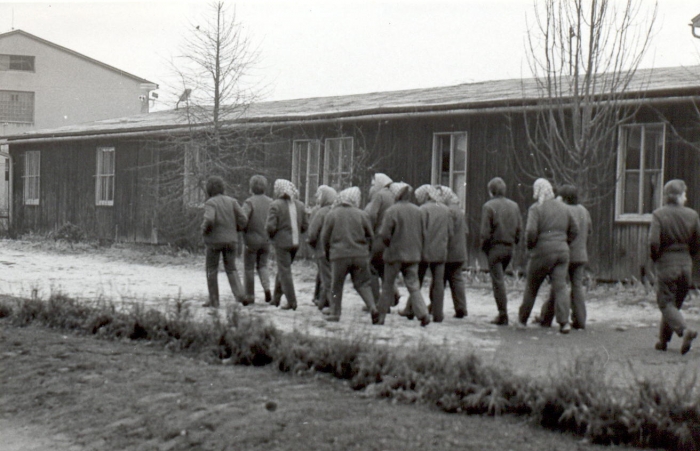
This research utilises personal narratives, collected through the oral history method as well as memoirs, autobiographies, personal correspondence, poems and objects created by women in prison. Other primary sources, including period official documentation, such as prison files archived by State Security, will be further compared with secondary literature.
Besides the thesis itself, I plan to create an online exhibition focused on prison culture. The main aim of the exhibition is to serve as an interactive educational tool which will tell the women’s stories. It will be based on period materials, excerpts from the lives of the selected women and description of methods and practices of State Security.