
JH Whitley and the Royal Commission on Labour in India: An Exhibition
by Paul Ward
J.H. Whitley, recently retired as Speaker of the House of Commons, was appointed to chair the Royal Commission on Labour in India in 1929. Whitley’s founding of the joint industrial councils to regulate labour relations was well known and he had some interest in imperial matters, as was unavoidable for British politicians in the early twentieth century. Whitley was a member of the Empire Parliamentary Association and as Speaker had welcomed parliamentarians from across the dominions and Empire to the Palace of Westminster.
Whitley’s papers were donated to Heritage Quay at the University of Huddersfield in 2012. Since then, we have been taking first year History students to visit the archives and use the papers to explore the connections between Yorkshire and the wider world. In 2016 a conference was held to explore the many facets of Whitley’s life and we decided to work with students to explore Whitley’s Indian expedition in more detail.
Paul Ward, professor of modern British history, and students in History, Amerdeep Panesar, Amy Stoddart and James Turner, joined with Sarah Wells, a student in textile practice decided to explore Whitley’s visits to India as part of the Royal Commission to think about the imperial nature of local politics in the early twentieth century. We were joined in the archives by other students – Lisa Bates, Katie McAdam and Madeleine Longtin – who helped think about the sources.
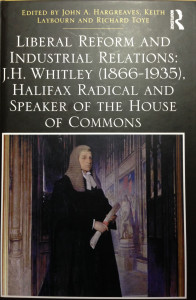
The result was a co-researched and co-written book chapter called JH Whitley and the Royal Commission on Labour in India, published in Liberal Reform and Industrial Relations: J.H. Whitley (1866-1935), Halifax Radical and Speaker of the House of Commons, a book edited by John Hargreaves, Keith Laybourn and Richard Toye. The co-productive methods were inspired by Paul Ward’s participation in Imagine: Connecting Communities Through Research, an interdisciplinary ESRC funded project that explore how knowledge resides in communities as well as universities and that collaborative research creates better knowledge.
Producing the chapter was a real collaborative effort. As well as a series of visits to Heritage Quay to read, discuss and analyse the Whitley papers held there, Amy went to Girton College Archives (funded by the Economic History Society) to look at the papers of Beryl Power, the only female member of the Royal Commission, and Paul Ward looked at India Office Papers at the British Library. We shared reading the 600-page report between all of us, and we met in a series of workshops to discuss our research (as well as to make a series of props for our exhibition at the 2016 conference).
We adopted a post-colonial approach to understanding Whitley’s role in reforming labour conditions in India, thinking about the ways in which it was intended to shore up an Empire in trouble and facing threats of nationalism and industrial unrest. However, we acknowledged, after some discussion, the sincerity of Whitley and the other commissioners in seeking to improve Indian living and working conditions.
The collective approach to research also encouraged us to think about our research from different perspectives. Our major source in the Heritage Quay papers was the series of scrapbooks that Whitley compiled, including a volume on his two trips to India put together by his wife, Helen. These were full of newspaper cuttings and photographs as well as dinner menus and seating plans. They revealed the day to day activities of the royal commissioners, they told us where they went and what notice British India took of them while they were there. Having Sarah, a textiles practice student, as co-researcher forced us more textually minded historians to think of the visual sources as key resources for our understanding. We were joined in the archives by other students – Lisa Bates, Katie Langan and Madeleine Longtin – who helped take notes and to think about the sources. This was collaborative research, crossing disciplines, made possible by the co-productive approach, which saw students as researchers.
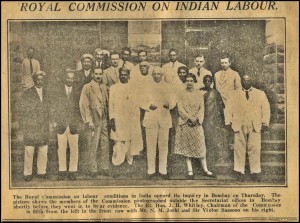
Newspaper photograph of JH Whitley and members of the Royal Commission on Labour in India
In another workshop we divided writing tasks, by thinking about the structure of the chapter as a whole. We divided the essay into sections, meaning we had around 1200 words each to write in the first draft. It meant that we could each choose the underpinning reading for our sections and that we could feel a sense of authorship as individuals.
When first drafts were submitted we had to think about how to connect sections and adjust each section to avoid repetition or lack of explanation. We then passed it over to a first-year history student, Charlotte Derbyshire, who read it for clarity and made some insightful comments. She said, “it’s about Whitley and the Royal Commission but I didn’t feel that I understood either after I had read it”, so we added greater clarity, greater discussion of that the Commission did and thought more about Whitley’s motives. It was enormously helpful to be able to present a good draft to the 2016 conference on JH Whitley, so that our work had been scrutinised by experienced academics before submission of the final draft to the editors for publication and we were lucky to have Keith Laybourn as chief editor for the book, since he dealt with all minor revisions himself.
We concluded that Whitley can be conceptualised as a man of his time, a liberal imperialist, fulfilling a role needed to maintain the colonial rule of India. He had considerable empathy for India workers – he told a BBC wireless audience on his return:
I would only ask you remember that all of you have a share in our joint responsibility for India, which was never greater than it is to-day, and that we shall not discharge our responsibility unless we try to understand the lives and circumstances of our fellow citizens across the seas.
Whitley expressed sincere concern and regard for the Indian people and especially its labouring classes, yet his speech suggested that their destiny would remain ‘our joint responsibility’ rather than being in their own hands. It was this that convinced most of us that Whitley considered that Britain’s future should remain imperial and that India should remain ‘British’.